
Three Pillars of Successful Business Transformation
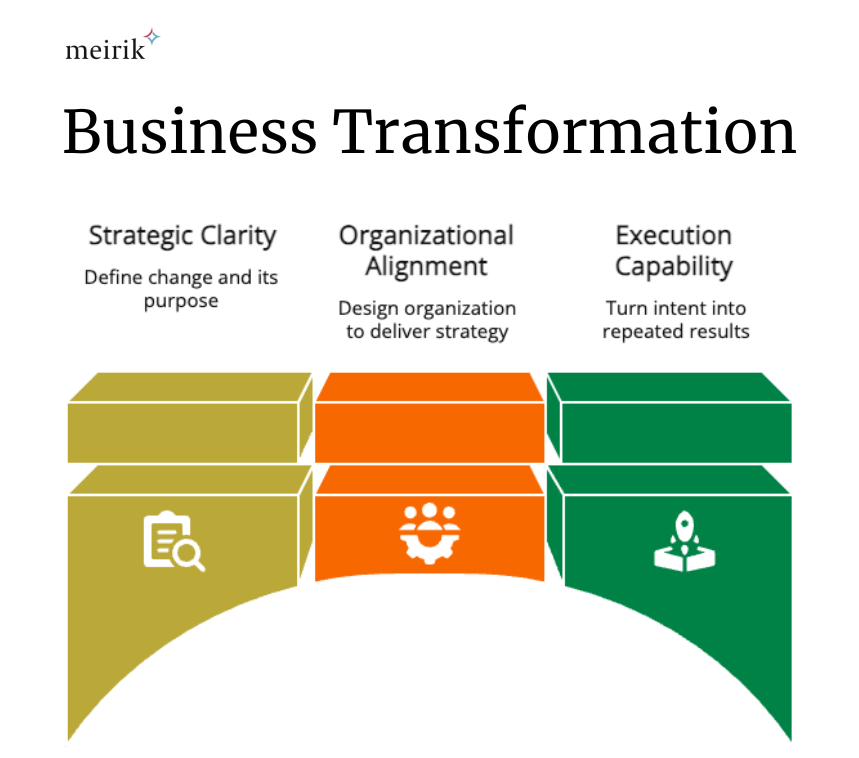
Most organisations don’t fail at transformation because they lack frameworks or tools.
They fail because they confuse activity with progress.
At Meirik, we work with leaders who are under pressure to deliver real change — faster decisions, better outcomes, andsystems that actually support the business. Over and over again, we see thesame truth:
Successful transformation rests on three pillars.
When one is weak, progress slows. When all three are strong, change compounds.
Pillar 1: STRATEGIC CLARITY
Know what must change - and why. Every transformation should start with a clear business question:
What outcome are we trying to change?
Not “become more agile”.
Not “modernise delivery”.
But something tangible — like reducing bid evaluation time, improving data reliability, or enabling faster investment decisions.
A good example comes from rhi, a global provider of cost and contracting software for large-scale energy infrastructure.
Their platform, rhiCOMS, plays a critical role in planning budgets, evaluating tenders, and tracking project progress across oil, gas, and renewable developments.
The challenge wasn’t that the software didn’t work.
It did - but it was built as a desktop system in a world that now needed instant, global access to data.
The transformation goal was clear:
Enable faster, data-driven decision-making for customers by moving rhiCOMS to the cloud.
That clarity shaped every decision that followed.
You can read the full story here.
When strategy is clear, teams don’t needconstant direction.
They can make trade-offs confidently, because they know what success looks like.
Pillar 2: ORGANISATIONAL ALIGNMENT
Design for how work really happens. Clear goals aren’t enough if the organisation isn’t set up to deliver them.
Misalignment shows up in familiar ways:
• Decisions escalate unnecessarily
• Teams juggle too many priorities
• Accountability is shared so widely that no one truly owns outcomes
In one of our client's case, redevelopment required in put from multiple internal stakeholders - technical experts, business users, and customer-facing teams.
Without alignment, the risk was obvious:endless requirements, slow decisions, and a system rebuilt for the past instead of the future. Instead, Meirik facilitated business and technology alignment workshops to:
• Group requirements around business outcomes
• Surface dependencies early
• Decide what not to build
This approach led to better choices - including removing low-value legacy functionality and introducing new, high-impact capabilities like integrated estimating and Power BI reporting.
Alignment isn’t about compromise.
It’s about designing structures, decision rights, and collaboration patterns that support the strategy - not fight it.
For a broader perspective on how lack of focus undermines value delivery, see this case study.
Pillar 3: EXECUTION CAPABILITY
Turn intent into results — repeatedly. Even with clear strategy and alignment, transformation fails if delivery depends on heroics.
Execution capability means being able to:
• Deliver value in small, meaningful steps
• Get fast feedback from real users
• Adapt before problems become expensive
At rhi, the redevelopment team intentionally chose to “fail quickly”.
They wanted stakeholders to say “no” early— while changes were still cheap.
This required:
• Cross-functional collaboration
• Frequent feedback loops
• Leaders focused on removing constraints, not adding pressure
The result?
After 18 months, the cloud-based rhiCOMS platform reduced bid evaluation from weeks to days — and created a scalable foundation for future growth.
Execution capability is built, not installed.
It comes from investing in people, skills, and leadership behaviours.
A powerful example of this approach at scale can be seen in our Delivery Management Development Programme.
Rather than expecting performance and hoping capability follows, the organisation chose to build capability first —and let it lead the transformation.
These pillars reinforce each other
- Strategy without alignment creates frustration
- Alignment without execution creates bureaucracy
- Execution without clarity creates waste
When all three are strong, transformation stops feeling like a programme - and starts becoming how the organisation operates.
Start where you are
No organisation gets this perfect from day one. The goal isn’t perfection - it’s focus.
Ask yourself:
- Is our strategy clear enough to guide real decisions?
- Is our organisation designed to support that strategy?
- Do we have the capability to execute and adapt?
Strengthen the weakest pillar first. That’s how transformation becomes real —and sustainable.
Ready to explore what this could look like for your organisation?
Contact us at contact@meirik.com